Why Your Power Stroke Is Down on Boost: Leaks, Sticking VGTs & the Parts That Fix It
Lost boost, slow spool, or a whistle under load on your Ford Power Stroke? Before you buy a turbo, work the real causes in order — blown intercooler boots, a sooted-up sticking VGT, tired boost control, and leaking turbo gaskets. Here's how to diagnose each and the exact parts that fix it on the 7.3, 6.0, and 6.7.
Parts Covered in This Guide — At a Glance
Restoring boost or chasing more power
Restoring boost or chasing more power
Restoring boost or chasing more power
Restoring boost or chasing more power
| # | Product | Owner Reviews | Availability | Best For | |
|---|---|---|---|---|---|
| 1 | 81 | $36.59 In Stock at Amazon | Restoring boost or chasing more power | ||
| 2 | 43 | $7.99 In Stock at Amazon | Restoring boost or chasing more power | ||
| 3 | 148 | $102.99 In Stock at Amazon | Restoring boost or chasing more power | ||
| 4 | 150 | $26.99 In Stock at Amazon | Restoring boost or chasing more power | Buy on Amazon
Prime Eligible
|
Few complaints are as common on a Ford Power Stroke as “it’s down on boost.” The truck feels flat, spool is lazy, there’s a whistle or a wheeze under load, or a gauge that used to see full boost now falls short. And the most common mistake owners make next is buying a turbo — when the real cause is almost always something cheaper. This guide walks the actual causes of lost boost in the order you should check them, and points each one at the right category and the exact parts to fix it: new on Amazon Automotive, used and OEM on eBay Motors.
Not sure which engine you’re working on? See the Super Duty generations & fitment guide. If you’ve already diagnosed the turbo itself and you’re shopping for more power, that’s a different job — see Best Power Stroke Turbo Upgrades for choosing a replacement or compound setup.
Diagnose First: Actual vs. Commanded Boost
Before you buy a single part, get a number. With a boost gauge (or a scan tool / tuner that reads boost), drive the truck under load and compare actual peak boost to what the truck is commanding. A large gap between the two is the tell: the engine is asking for boost it isn’t getting, which means air is leaking out or the turbo isn’t responding. A tuner or monitor that logs commanded-vs-actual boost turns this from guesswork into a five-minute test drive. Once you know there’s a shortfall, work the list below top to bottom — the cheap, common failures first.
1. Boost Leaks — The #1 Cause (Especially the 6.0)
The single most common reason a Power Stroke loses boost is a leak in the charge-air path — the pipes and rubber boots that carry pressurized air from the turbo, through the intercooler, and into the intake. Under heat and boost cycles those boots crack, split, or slip off their clamps, and the boost you’re making dumps out before it reaches the cylinders.
On the 6.0L (2003–2007) this is a signature failure: the intercooler boots and their clamps are a known weak point, and a blown cold-side or hot-side boot is the classic “I lost all my boost overnight” story. The fix is cheap and permanent — a fresh 6.0 turbo intercooler boots & clamps kit with upgraded T-bolt clamps seals the whole charge path back up. Inspect every boot for oil residue and cracks, and make sure each clamp is tight. Browse the turbos category for boots, couplers, and clamp kits.
How to confirm: squeeze each boot with the engine off looking for splits; better yet, do a shop-air boost-leak test — pressurize the intake and listen for the hiss. Seal the leaks before you blame the turbo. For how the whole charge-air path fits together — filter, intercooler, boots, and the CCV oil mist that coats them — see the intake & airflow guide.
2. Sticking VGT (6.0 & 6.4) — Soot on the Vanes
The 6.0L and 6.4L use a variable-geometry turbo (VGT) whose movable vanes tune exhaust flow to spool the turbo across the RPM band. Soot and oil bake onto the vanes and the unison ring until they stick, and you get lazy spool, surging boost, or no boost at all — often with an actuator trouble code.
Work it in order: run the tuner’s VGT-exercise routine (or cycle the actuator manually) to free lightly-stuck vanes, then physically clean the vanes and unison ring, then replace the electronic actuator if it has failed. Only if the vanes or shaft are physically worn does the cartridge or turbo itself need replacing. When you do pull the turbo for cleaning or service, plan to reseal it — see the mounting gaskets below. Regular exhaust-brake use and clean oil and filters slow the sticking down for good.
3. Reseal When You Service: Turbo Mounting Gaskets
Any time the turbo comes off — for a VGT cleaning, an actuator swap, or a replacement — reuse nothing. The turbo pedestal, mounting flanges, and oil feed/drain lines seal with gaskets and o-rings that harden and leak with heat. A leaking mounting or drain gasket shows up as an exhaust tick, an oil weep, or boost bleeding off at the pedestal.
For the 6.0L (2003–2010), a complete turbocharger mounting kit with gaskets, o-rings & bolts reseals the turbo properly so your cleaning or replacement actually holds boost. It’s a few dollars of gaskets that save you pulling the turbo twice. Fresh hardware also means you’re not fighting seized or stretched bolts on reinstall.
4. Boost Control on the 7.3 — Wastegate & Pedestal
The 7.3L (1994.5–2003) uses a fixed-geometry turbo, so there are no vanes to stick — boost is managed instead by a wastegate and an exhaust-backpressure (EBP) system in the turbo pedestal. Two things go wrong with age:
- Wastegate / boost-control circuit. A failing boost-control (wastegate) solenoid or a cracked emission-vacuum harness makes boost erratic — it surges, spikes, or falls flat. Replacing the 7.3 turbo emission vacuum harness & wastegate boost solenoid restores clean boost control on the older trucks.
- Pedestal & EBP. The pedestal houses the exhaust backpressure valve that helps the 7.3 warm up and manages backpressure. A tired or leaking pedestal hurts warm-up and boost behavior; a 7.3 EBP valve upgrade pedestal & exhaust housing rebuilds that assembly and is a common fix when chasing 7.3 boost and backpressure gremlins.
Because these are older, often-discontinued fixed-geometry parts, eBay Motors is frequently the better source for good used and OEM 7.3 pedestals and wastegate hardware — see the rail below.
5. Then, and Only Then, the Turbo Itself
If the charge path is sealed, the VGT is clean and moving, the boost-control parts are good, and you still have a shortfall — now suspect the turbo. Check for shaft play (any wiggle is bad), damaged wheels, or oil passing into the intake or exhaust from failed seals. That’s a genuine turbo failure, and it’s the point where a rebuild, a cartridge, or a replacement makes sense. For choosing that replacement — stock-style, drop-in upgrade, or compounds — see Best Power Stroke Turbo Upgrades.
Order of Operations
- Get a number — actual vs. commanded boost with a gauge or tuner.
- Seal the leaks — intercooler boots & clamps, the #1 cause on the 6.0.
- Free / clean the VGT — exercise, clean, then actuator (6.0 / 6.4).
- Reseal on reassembly — fresh mounting gaskets and o-rings.
- Fix boost control — 7.3 wastegate solenoid, harness, and pedestal.
- Only now — suspect the turbo itself.
Nine times out of ten, a “dead turbo” Power Stroke just needs a boot, a cleaning, or a boost-control part. Diagnosing in this order is what keeps a boost problem a cheap problem. For the engine-specific context behind these failures, see the 6.0 Power Stroke problems guide and the 7.3 Power Stroke weak points guide; to keep soot and heat from re-sticking a VGT, the EGR & cooling guide covers the upstream causes.
Shopping used or OEM? Try eBay Motors
Live listings for the parts covered in this guide — prices set by the seller.
Recommended Parts for This Guide

6.0 Turbo Intercooler Boots Clamps Kit For Ford F250 F350 Super Duty Excursion Econoline 6.0L Powerstroke Diesel 6.0 Turbo Intercooler Pipe Boot Kit 2003-2007 with T Bolt Clamp
81 owner reviews
6.0 Turbo Intercooler Boots Clamps Kit 2003-2007 6.0 Intercooler Pipe Boot Kit For Ford F250 F350 6.0L Powerstroke Diesel with T Bolt Clamp. Turbocharger hardware for the Power Stroke — restore lost boost or add drop-in and compound turbo power.
- Restores lost boost
- Drop-in & upgrade options

Turbocharger Mounting Kit with Gaskets O-Rings &Bolts 904-234 3C3Z-9T514-AG | Fit for 6.0L Powerstroke Diesel 2003-2010 Ford,2002-2010 International Trucks Replaces# 3C3Z-9T514-AD
43 owner reviews
Turbocharger Mounting Kit with Gaskets O-Rings and Bolts Compatible with 6.0L Powerstroke Diesel 2003-2010 Ford,2002-2010 International Trucks Replaces# 904-234, 3C3Z-9T514-AG, 3C3Z-9T514-AD. Turbocharger hardware for the Power Stroke — restore lost boost or add drop-in and compound turbo power.
- Restores lost boost
- Drop-in & upgrade options
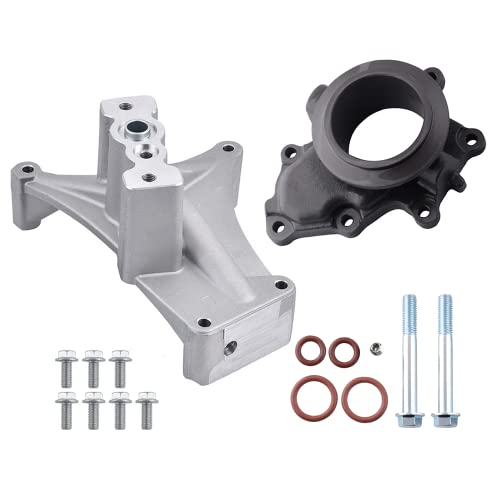
EBP Valve Upgrade Turbo Pedestal & Exhaust Housing Compatible with Ford 7.3L Powerstroke 1999.5-2003 Bolts & Exhaust Housing + Diesel Turbo Pedestal
148 owner reviews
SPELAB EBP Valve Upgrade Turbo Pedestal & Exhaust Housing Compatible with Ford 7.3L Powerstroke 1999.5-2003 Bolts & Exhaust Housing + Diesel Turbo Pedestal. Turbocharger hardware for the Power Stroke — restore lost boost or add drop-in and compound turbo power.
- Restores lost boost
- Drop-in & upgrade options

Turbo Emission Vacuum Harness Connection Line and Wastegate Boost Solenoid Fits for Ford F250 F350 F450 F550 Super Duty 1999-2003 7.3L Diesel Powerstroke Engines Replace F81Z-6C673-AA F81Z-9E498-DA
150 owner reviews
Turbo Emission Vacuum Harness Connection Line and Wastegate Boost Solenoid Fits for Ford F250 F350 F450 F550 Super Duty 1999-2003 7.3L Diesel Powerstroke Engines Replace F81Z-6C673-AA F81Z-9E498-DA. Turbocharger hardware for the Power Stroke — restore lost boost or add drop-in and compound turbo power.
- Restores lost boost
- Drop-in & upgrade options
Frequently Asked Questions
Why is my Power Stroke down on boost?
How do I find a boost leak on a Power Stroke?
What is a sticking VGT and how do I fix it?
Do I need to replace the turbo, or just service it?
How does boost control work on the 7.3 Power Stroke?
Why does my boost surge or spike, then drop?
Keep going
Shop the parts in this guide
- Turbos for the Power Stroke Turbochargers, VGT units, turbo rebuild kits, and upgrade turbos for the Power Stroke diesel — restore stock boost or add drop-in and compound turbo power.
- Air Intake for the Power Stroke Cold air intakes, intake elbows, intercooler pipes, and boost tubes that free up airflow and feed the Power Stroke turbo more cool, dense air.